
Lafourche Parole and Probation
Parole and probation both allow a person to live outside a jail or prison, but they arise in different ways. The Louisiana Committee on Parole may grant parole to an eligible imprisoned person after its review. Probation generally comes from the court as a community sentence or as part of a suspended sentence. Lafourche Parish cases may therefore lead to the same local supervision office through two distinct legal paths. Neither status means that every part of the sentence or case has ended.
The Louisiana Department of Public Safety & Corrections, Division of Probation and Parole/Adult, supervises adjudicated people in the community. A LAVNS result that names a probation and parole district can show the current supervising arm. Court minutes help establish probation, while a Committee on Parole result documents a parole decision. An agency discharge record is needed to show that supervision itself ended.
| Point | Parole | Probation |
|---|---|---|
| How it begins | A Committee on Parole decision or a statutory release status | A court order, often tied to a suspended sentence |
| Best first record | Parole result, DPS&C or LAVNS status | Court minute and DPS&C supervision status |
| What it proves | Community release under stated legal terms | Court-ordered community supervision |
| How it ends | Discharge, expiration, or other official action | Court or agency completion and discharge record |
- Parole
- Release from confinement while part of the sentence remains subject to legal terms.
- Probation
- A court-ordered community sentence or suspended portion administered by the supervising agency.
- Discharge
- The official end of the supervision status shown by the responsible court or corrections agency.
- Absconder
- A supervision label for a person alleged to have stopped reporting or whose location is unknown.
Verify Lafourche Post-Release Supervision
Begin with the legal name, date of birth, and any DPS&C or court number. Those identifiers reduce the risk of matching the wrong Lafourche Parish person. Louisiana routes its public corrections lookup through LAVNS and VINELink. DPS&C says the service includes imprisoned people and people on probation or parole and updates every 24 hours. The reporting agency and status matter more than a name alone.
- Choose Louisiana in LAVNS/VINELink and search the full name. Narrow the match with an ID or case number when available.
- Open the correct record. Record the agency, location or status, event date, supervising district, and last-updated details.
- Check the Lafourche Parish court minutes when probation may be court ordered. A minute can show a suspended term, probation, later amendment, or revocation action.
- For parole, review the official parole docket hub and result. A scheduled hearing is not a decision, and a grant is not the actual gate date.
- Contact the assigned district for public verification if the electronic record is unclear. Ask about the status, not confidential plans or reports.
- Request a discharge record from DPS&C when the question is whether Lafourche Parish supervision ended.
The Lafourche Parish released-inmate search path explains how to verify the earlier move out of parish custody. It can be paired with the supervision check when the release type is not yet clear.
Note: A LAVNS status is an alert and lookup layer, while a court minute or agency record documents the legal action itself.
Lafourche Supervision Office Access
The verified local access point is the DPS&C Thibodaux District. It serves Lafourche, St. Charles, and Terrebonne parishes. Use the assigned district shown by the locator before assuming this office has the file. If Thibodaux is named, staff can provide the public supervision information that may not be clear in a dynamic online result.
Thibodaux Probation and Parole
Agency: Louisiana DPS&C, Division of Probation and Parole/Adult
Address: 1404 Tiger Drive, Thibodaux, LA 70301
Phone: (985) 447-0935
Fax: (985) 447-0827
Hours: Monday through Friday, 8:00 a.m. to 4:30 p.m.
The official Thibodaux District page is the source for the office territory and contact details. Its captured office view is shown below.
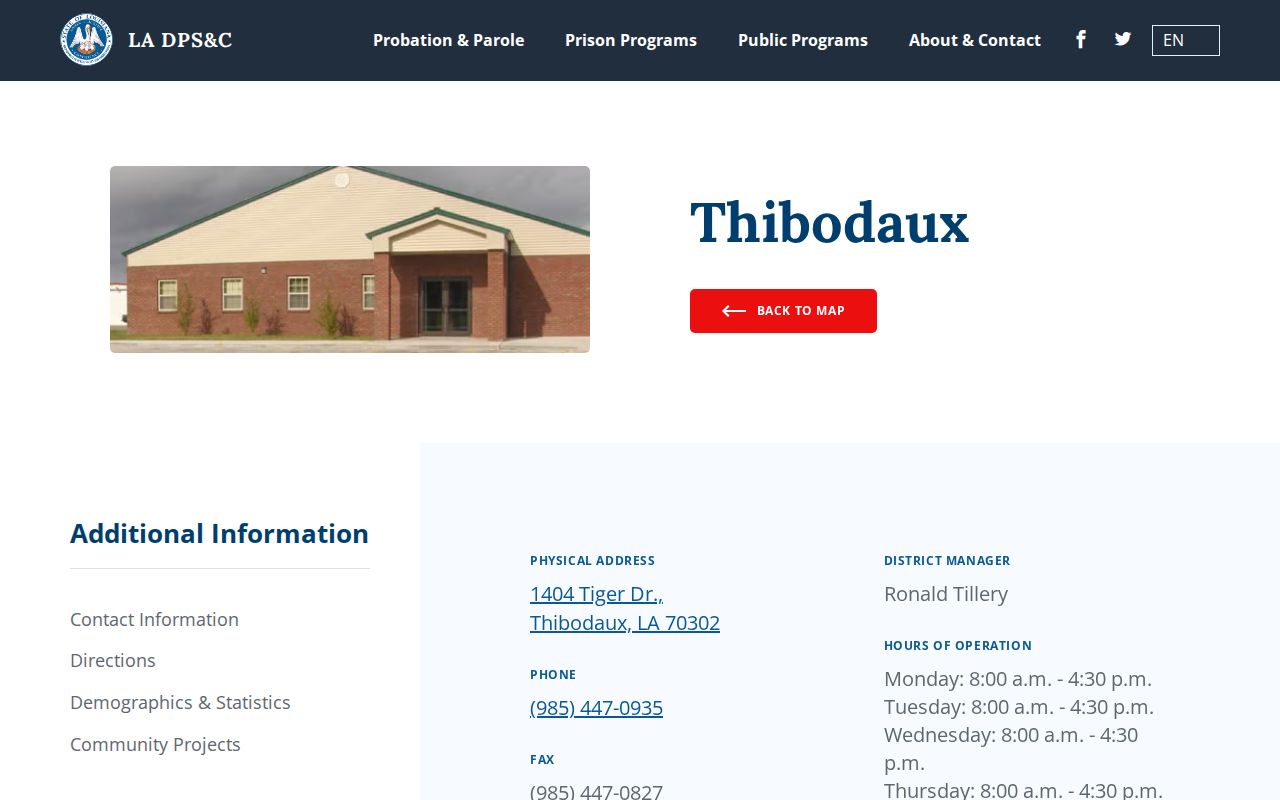
This office page supplies a human verification route after the statewide lookup assigns a Lafourche Parish supervision district.
Lafourche Transitional Release Status
The Lafourche Transitional Work Program is a local point where custody and release can be confused. LPSO operates the program through an agreement with DPS&C. It serves screened people who are nearing release, but its community-confinement classification means participants remain confined. Work outside the site does not by itself establish parole, probation, or discharge.
A departure from the program can lead to several outcomes. The person may discharge to the community, begin supervision, return to a secure site, or transfer under another legal status. Confirm the outcome through DPS&C/LAVNS and the program record. The event should never be inferred from the program’s “transitional” name.
Note: Assignment to the Lafourche Transitional Work Program is still custody and must not be labeled a completed release.
Lafourche Warrants After Release
LPSO maintains an Active Warrants function separate from its current-inmate view. That split is important after a Lafourche Parish release. A person can leave LPCC while another warrant remains active. At the same time, a name on the warrant list does not prove a new arrest, a parole violation, or present jail custody.
Read the systems separately. Match stable identifiers, note the agency named on the warrant, and confirm with that authority. A supervision absconder label also deserves careful wording. It identifies an alleged reporting or location problem in the supervising system, not a final court finding by itself. If LAVNS shows a return to custody, confirm which custodian accepted the person and what event caused the change.
Lafourche Supervision Changes and Violations
Conditions are the rules attached to community supervision. The exact terms belong to the person’s order and agency record, not to a generic list. An alleged violation can prompt a warrant, preliminary process, revocation hearing, modification, or return to custody. These are separate stages. A docket proves that a matter was set; a final result records the decision.
The Committee on Parole publishes separate revocation material. Its records can distinguish a scheduled proceeding from the final outcome. Likewise, a favorable parole grant may still be followed by release planning, program placement, a detainer, or record processing. The actual release event should be checked through DPS&C/LAVNS, then documented by the agency record.
Louisiana law also creates different forms of release after earned credits. Under the legacy framework, R.S. 15:571.5 can place a person on supervision for the balance of the original term. For many eligible offenses on or after August 1, 2024, R.S. 15:571.3.1 instead describes unsupervised parole for the remainder, subject to its terms and exclusions. “Good time” therefore does not always mean the same supervision status.
Lafourche Parole Hearing Records
The Louisiana Board of Pardons and Committee on Parole publishes a process page, recurring hearing notices, annual schedules, and a searchable legacy result interface. The docket hub archives material from 2012 forward. A weekly notice identifies the cases set for that hearing period, while the annual calendar only shows broader board and committee activity. Search the result by name and hearing date before drawing a conclusion.
The Committee on Parole alone grants parole. A decision may grant or deny it, and a denial may give reasons or state when rehearing can be considered. Reconsideration under the published policy is not a formal appeal. Preliminary and revocation proceedings address alleged supervision violations through a separate process. Terms such as “deferred” or “rescinded” should be used only when the person-specific result uses them.
A grant is still not the Lafourche Parish release date. Conditions, placement work, a detainer, and records processing can keep the person confined after the hearing. Compare the result with the later LAVNS/DPS&C status and request the actual release record. If a person later returns to custody, use the revocation docket and final outcome rather than treating an allegation or scheduled hearing as a completed revocation.
Lafourche Supervision Discharge Records
Supervision ends through an official action, expiration, or discharge reflected by the responsible court or DPS&C record. A person who is no longer found in a dynamic public locator may have fully discharged, but a blank result alone is inconclusive. Search aliases and agency numbers, then request the existing public record rather than guessing.
Louisiana R.S. 15:574.12 protects many corrections materials but makes specified general information public on request. That public set includes the disposition of charges or incarcerations and the discharge date. A focused request should identify the person by DPS&C number when known and ask for the public supervision status and discharge date. Confidential pre-parole, case-planning, and staff-gathered reports remain outside that narrow request.
A final discharge is different from release to parole, release on good-time status, probation, or transfer. Use the recorded label. That precision gives Lafourche Parish families, attorneys, and record requesters a sound answer without treating every community status as the same event.
Note: Full Lafourche Parish discharge should be supported by the final court or DPS&C record, not inferred from a missing locator entry.