
Lafourche Projected Versus Actual Release
Louisiana uses the term “projected release date” for the date produced by the official sentence computation. DPS&C can provide it by telephone if a calculation applies. It may not yet exist when signed sentencing paperwork has not reached the agency. Even after one appears, later jail credit, a corrected sentence, an eligibility decision, earned credits, forfeiture, another judgment, or routine processing can change it.
An actual release date records an event that already happened. For a person at Lafourche Parish Correctional Complex, that event may be community release or a transfer to another custodian. For a state prisoner, the date may mark release to parole, good-time status, or final discharge. The label and receiving agency must be read with the date.
A pretrial detainee has no sentence to compute. Bond approval, dismissal, a court release order, transport, and unresolved holds can control the timing. A posted bond does not by itself prove that LPCC completed the release process.
Find a Lafourche Inmate Release Date
The correct route starts with the type of custody. Louisiana does not offer a separate historical DOC release database on its information page. DPS&C directs the public to LAVNS/VINELink, its automated telephone locator, and records offices. A parish-sentence question goes to the jail and court. A state-sentence question follows the state calculation.
- Gather the full legal name, date of birth, booking number, DPS&C number, and Lafourche Parish docket number when available.
- Check the LPSO current roster only to learn whether the person remains rostered. Absence does not prove release.
- For a state sentence, use the DPS&C inmate-information route to LAVNS, then call the automated locator at (225) 383-4580. It provides a projected date if applicable.
- For a parish sentence at LPCC, ask the jail for the official release calculation and recorded disposition. Pair it with the signed court sentence and credit for time served.
- If computation is disputed, follow DPS&C’s stated process. State-facility questions go to the facility Records Office; a person housed locally uses the written Administrative Remedy Procedure.
- After the expected date, obtain the final release or transfer record. That record confirms whether departure led to the community, supervision, or another custodian.
The Lafourche Parish released-inmate record path covers the final verification after a name leaves the live roster. It also explains how to ask LPSO for the release type and receiving agency.
Note: The DPS&C automated locator needs a DPS&C number or a name and date of birth to narrow the result.
Lafourche Release Credit Date Break
Louisiana sentence-credit law has a key offense-date break. R.S. 15:571.3 contains the legacy rules for offenses committed before August 1, 2024. Those rules do not produce one universal percentage. Sentence type, offense category, conviction history, exclusions, and custody setting can change both eligibility and the earning ratio. Certain older parish sentences without hard labor, for example, used a different ratio from violent and state nonviolent categories.
For offenses committed on or after August 1, 2024, R.S. 15:571.3(H) directs ordinary eligibility to the newer R.S. 15:571.3.1 framework. That section allows an eligible felony offender in parish prison or DPS&C custody to earn good time up to fifteen percent of the sentence. It excludes sex-offense convictions and habitual offenders from the basic rule, treats some program credits separately, bars good time on credit-for-time-served time under Article 880, and permits forfeiture.
That is why a blanket “85% rule” is not safe. “Up to 15%” is a useful shorthand for some eligible new-law cases, but it does not apply to every person. The offense date and official classification must come first. DPS&C’s current projected release date controls over an informal calculation.
The official Louisiana good-time statute displays the legacy framework and transition language in context.
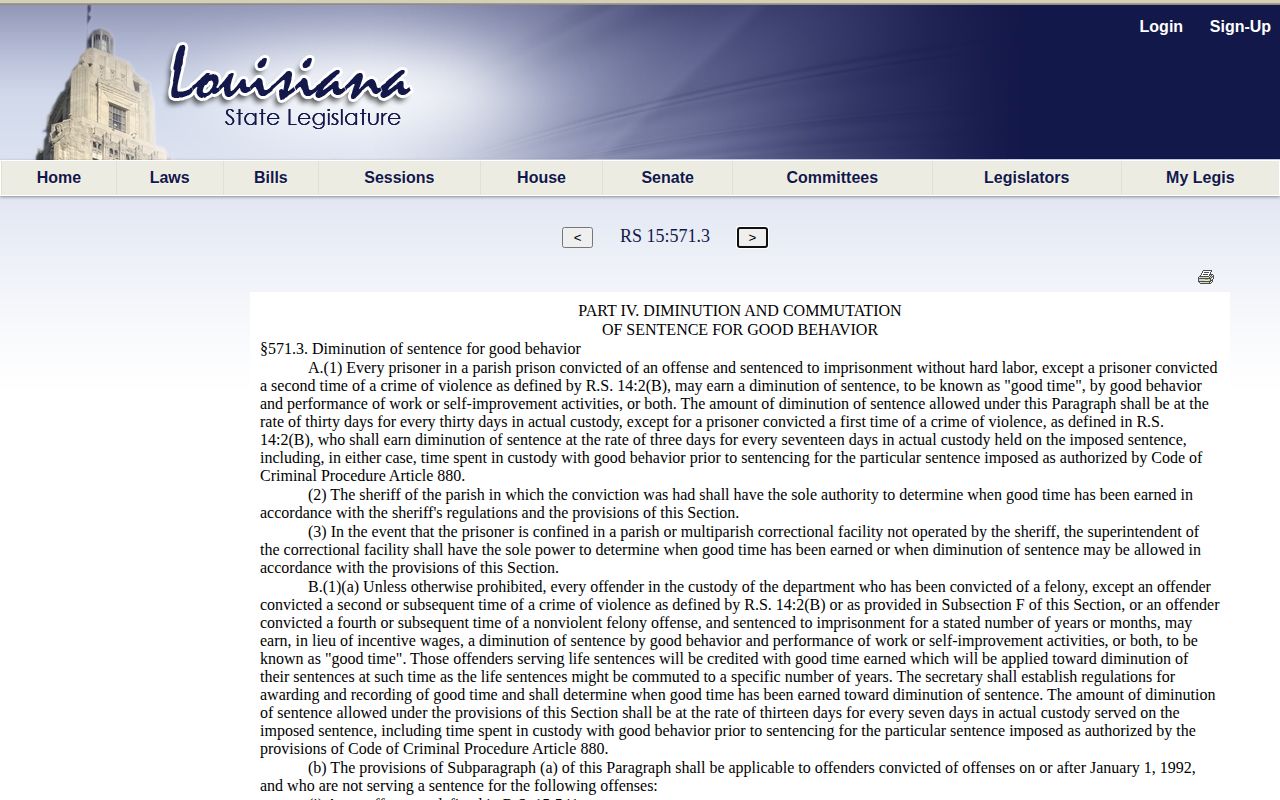
The captured statute is useful for identifying the applicable regime, but it cannot replace DPS&C’s person-specific sentence computation.
Compute Lafourche Projected Release Dates
A sound computation begins with the signed sentence and offense date. It then applies credit for time served, identifies whether multiple terms run at the same time or one after another, classifies statutory exclusions, and adds eligible earned credits. Any forfeiture must also be included. Parole eligibility is calculated as a separate milestone.
- Concurrent
- Two or more terms run at the same time as stated in the judgment.
- Consecutive
- One term runs after another, extending the combined span.
- Good time
- A statutory sentence credit that may reduce confinement for an eligible person.
- Forfeiture
- Loss of earned credit under the governing law after specified conduct or events.
- Detainer
- A notice that another authority may seek custody, which can change where the person goes.
R.S. 15:571.4 governs forfeiture and restoration of credits and refers to the projected good-time parole supervision date. Misconduct, escape, and other statutory events can affect credit. R.S. 15:571.5 addresses supervision after a legacy diminution release. Under many new-law cases, R.S. 15:571.3.1 generally places the remaining term on unsupervised parole, with special rules for split sentences.
Lafourche Parish custody adds another distinction. The sheriff makes designated parish-prison determinations, while the DPS&C secretary determines state good-time matters. A person may be physically housed in a local jail while serving a state term. Confirm which authority controls before relying on a date.
Lafourche Release Dates Can Change
A projected date is recalculated when an input changes. Some changes move the date. Others change the legal status or destination without changing the day at first. The table identifies the record that should be checked for each cause.
| Factor | Possible effect | Record to confirm |
|---|---|---|
| Late sentencing papers | No date yet or a later first calculation | Signed judgment and Master Prison Record |
| Jail credit or correction | Changes time already credited | Court order and official computation |
| Earned credit | May move the projected date earlier | DPS&C or sheriff calculation |
| Credit forfeiture | May move the date later | Official credit record under R.S. 15:571.4 |
| New judgment | Adds, removes, or restructures a term | Court minute and amended computation |
| Detainer or hold | May cause transfer instead of community release | Release record and receiving agency |
| Parole action | Creates or denies a distinct release path | Committee result and DPS&C status |
Administrative processing also matters. A favorable parole decision does not mean the person exits that day. Required planning, program placement, a detainer, and final records work may remain. The hearing result and physical release date are separate records.
Note: A parole eligibility date permits consideration under the applicable law; it is neither a grant nor a release date.
Lafourche Parole Eligibility Dates
Parole eligibility must not be folded into the projected release date. For applicable offenses before August 1, 2024, R.S. 15:574.4 contains a general 25% consideration rule with major exclusions. Qualifying crimes of violence may require 65%, some repeat violence or sex cases may require 75%, and some categories are not eligible. Those figures describe statutory gates, not guaranteed release.
R.S. 15:574.22 generally ends parole eligibility for offenses committed on or after August 1, 2024, except for listed special categories. The offense date again controls the starting framework. If a case remains eligible, a hearing docket proves scheduling, while the result records whether the Committee on Parole granted or denied release.
Even a grant can leave the person confined while DPS&C completes the process. Check LAVNS and the agency record after the decision. When a Lafourche Parish person begins community supervision, the assigned P&P district may appear in the locator. That new status is not full legal discharge.
Lafourche Master Prison Record Checks
After DPS&C calculates a state sentence, the imprisoned person receives a Master Prison Record. That record is the right starting point for a question about the agency’s official dates and credits. A public court docket supplies crucial inputs, but it should not be used to rebuild the calculation from scratch. The agency must also account for its classification decisions, credit entries, forfeitures, and later corrections.
A state-facility calculation question goes to that facility’s Records Office. When a state-sentenced person remains in a Lafourche Parish local facility, DPS&C directs the person to use the written Administrative Remedy Procedure. An outside requester should ask for the existing public calculation or discharge information instead of trying to litigate another person’s computation by phone.
The custody stage still matters. A Lafourche Parish court sentence to DPS&C may cause LPCC to record a transfer to the state. The parish release or movement record gives the receiving agency and time. DPS&C then supplies state placement and the projected date. Those records can both be correct because they describe two successive custodians.
If the calculated date conflicts with a court minute, identify the exact docket, booking number, judgment, and disputed field. Present the court source to the records office through the stated process. The final agency correction, if one is made, should be confirmed in the updated Master Prison Record or official response.
Confirm Lafourche Actual Release Dates
After the projected day arrives, use the custodian’s event record. For LPCC, request the release date and time, release type, authority, remaining holds, and any receiving agency. A current-roster disappearance cannot show whether the person went home, entered state custody, or moved to a federal or immigration authority.
For a state sentence, check LAVNS and request DPS&C’s public discharge information. Louisiana R.S. 15:574.12 makes specified general facts, including discharge date and disposition of incarceration, public on request despite broader corrections-record limits. If the person is on parole or probation, the record should state that community status rather than being described as unconditional discharge.
VINELink can supply an alert when the contributing agency reports a custody change. It remains an alert layer, not a certified instrument. Preserve the agency name, event date, and last-updated time, then verify with the agency that held the person. This last check turns a forecast into a documented Lafourche Parish release event.
Note: Confirm the destination as well as the date because a Lafourche Parish departure may be a transfer to another custodian.